Search is evolving rapidly, and so is optimization. Recent studies indicate that more than half of all searches now end without a click because users receive answers directly from search engines and AI-powered platforms.
This shift means businesses can no longer rely solely on traditional rankings.
To stay visible, brands must optimize for AI-generated answers, conversational search, and intelligent discovery systems.
For years, Search Engine Optimization (SEO) has been the foundation of digital marketing.
As search behavior evolved, Answer Engine Optimization (AEO) emerged. Today, marketers are increasingly discussing Generative Engine Optimization (GEO) and AI Optimization (AIO).
Are these simply new buzzwords, or do they represent the future of digital visibility?
The reality is that SEO, AEO, GEO, and AIO are not competing strategies. Instead, they work together as different layers of visibility within an AI-powered search ecosystem.
Understanding each approach can help businesses build a stronger digital presence and remain competitive in the age of artificial intelligence.
What is SEO (Search Engine Optimization)?
SEO is the practice of optimizing a website to achieve higher rankings on search engines such as Google and Bing. The primary objective is to increase organic visibility and drive qualified traffic through search engine results pages (SERPs).
Key Components of SEO
- Keyword Research
- On-Page Optimization
- Technical SEO
- Link Building
- Content Optimization
- Mobile Experience
- Page Speed Improvements
For decades, SEO success has been measured by metrics such as keyword rankings, organic traffic, and click-through rates. While SEO remains a critical marketing channel, modern search behavior is changing. Users increasingly receive information directly within search results, reducing the number of website visits generated from traditional rankings.
SEO remains essential, but it is no longer the complete solution.
What is AEO (Answer Engine Optimization)?
Answer Engine Optimization (AEO) focuses on helping content become the direct answer to a user’s question. Rather than simply ranking pages, AEO aims to position content where search engines and AI systems display immediate answers.
Examples include:
- Featured Snippets
- Voice Search Results
- AI Overviews
- Conversational Search Experiences
The goal of AEO is to ensure your content is selected as the preferred answer source.
Key AEO Strategies
- Creating question-based content
- Writing concise answers
- Implementing schema markup
- Optimizing FAQ sections
- Structuring content for easy extraction
While SEO asks, “How do we rank higher?” AEO asks, “How do we become the chosen answer?”
What is GEO (Generative Engine Optimization)?
Generative Engine Optimization (GEO) is designed for AI-powered platforms such as ChatGPT, Gemini, Perplexity, Claude, and Microsoft Copilot.
Unlike traditional search engines, generative AI systems create responses by synthesizing information from multiple sources. GEO focuses on increasing the likelihood that your brand, content, or expertise is included in those AI-generated responses.
The goal is not necessarily to rank first but to become a trusted source that AI systems reference, cite, or recommend.
GEO Best Practices
- Establish strong topical authority
- Build consistent brand mentions
- Strengthen E-E-A-T signals
- Improve entity recognition
- Earn high-quality backlinks
- Publish expert-led content
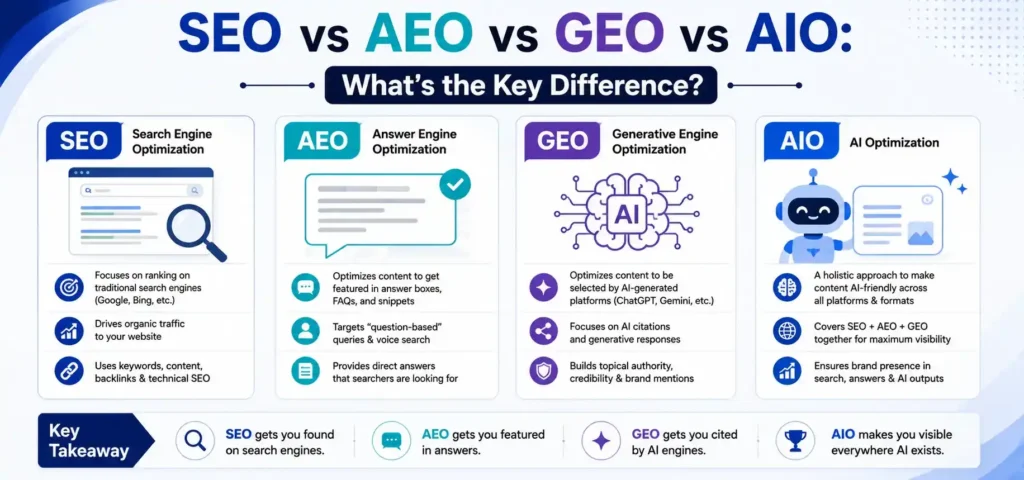
SEO focuses on rankings. AEO focuses on answer selection. GEO focuses on AI-generated citations and recommendations.
This represents one of the biggest shifts in digital marketing since the introduction of search engines.
What is AIO (AI Optimization)?
AI Optimization (AIO) is the broadest and most advanced form of digital optimization.
Rather than focusing exclusively on search visibility, AIO prepares a business for the entire AI ecosystem.
This includes:
- AI Search Platforms
- Conversational Interfaces
- Recommendation Engines
- AI Assistants
- Knowledge Graphs
- Predictive Algorithms
The goal of AIO is to make content, data, and digital assets understandable, trustworthy, and machine-readable for artificial intelligence systems.
Core Elements of AIO
- Structured Data Implementation
- Knowledge Graph Alignment
- Brand Entity Optimization
- Content Clarity
- Data Consistency
- AI-Friendly Website Architecture
If SEO is ranking-focused and AEO/GEO are visibility-focused, AIO is ecosystem-focused.
SEO vs AEO vs GEO vs AIO: Key Differences
| Strategy | Primary Focus | Visibility Type | Success Metric |
| SEO | Search Rankings | Search Results | Organic Traffic |
| AEO | Direct Answers | Snippets & Voice Search | Answer Inclusion |
| GEO | AI Citations | AI-Generated Responses | Brand Mentions |
| AIO | AI Readiness | Cross-Platform AI Visibility | Authority & Adaptability |
Each layer builds upon the previous one. Businesses should view them as complementary rather than competing approaches.
Why This Evolution Matters
Search is transitioning from:
Keyword-Based Search → Answer-Based Search → AI-Powered Discovery
Success is no longer defined only by rankings.
Modern visibility depends on:
- Being discovered
- Being extracted
- Being cited
- Being summarized
- Being trusted
Brands that adapt early gain a significant advantage in AI-driven search environments.
A Strategic Approach for Businesses
Step 1: Build Strong SEO Foundations
Focus on technical SEO, keyword targeting, site architecture, and high-quality content.
Step 2: Implement AEO Strategies
Create FAQ sections, answer-focused content, structured data, and featured snippet opportunities.
Step 3: Strengthen GEO Signals
Publish authoritative content, earn credible mentions, and build strong brand entities.
Step 4: Adopt AIO Thinking
Align your content, data, and digital infrastructure with the requirements of AI systems and future search technologies.
Final Thoughts
The future of search extends far beyond rankings. SEO established the foundation for online visibility. AEO helps brands become the answer. GEO helps businesses appear in AI-generated responses. AIO ensures organizations are prepared for the broader AI ecosystem.
Businesses that invest in these strategies today will be better positioned to gain authority, visibility, and trust in tomorrow’s search landscape.
Frequently Asked Questions (FAQs)
1. What is GEO (Generative Engine Optimization)?
GEO is the process of optimizing your brand and content to appear in AI-generated responses from platforms such as ChatGPT, Gemini, Perplexity, and Microsoft Copilot.
2. How is GEO different from SEO?
SEO focuses on improving rankings in traditional search engines, while GEO focuses on increasing the chances of your brand being cited, mentioned, or recommended in AI-generated answers.
3. What is AEO (Answer Engine Optimization)?
AEO helps content appear as direct answers in featured snippets, voice search results, AI overviews, and other answer-based search experiences.
4. What is AIO (AI Optimization)?
AIO is a broader strategy that ensures your website, content, and brand are structured and optimized for AI systems, recommendation engines, and conversational search platforms.
5. Is SEO still important in 2026?
Yes. SEO remains the foundation of online visibility. GEO, AEO, and AIO build upon SEO rather than replace it.
6. Why should businesses invest in GEO?
As more users rely on AI-powered search tools, GEO helps businesses improve visibility, brand authority, and the likelihood of being recommended by AI platforms.
7. Can GEO help generate more leads?
Yes. Increased visibility in AI-generated responses can drive more brand awareness, qualified traffic, and potential leads.
8. Which is better: SEO, AEO, GEO, or AIO?
None of them are better individually. The most effective strategy combines SEO, AEO, GEO, and AIO to maximize visibility across both traditional and AI-powered search platforms.
9. How long does it take to see results from GEO?
Results depend on factors such as brand authority, content quality, and competition. Most businesses begin seeing improvements over several months.
10. Does Search Engine Lab offer GEO services?
Yes. Search Engine Lab provides GEO, SEO, AEO, and AI visibility solutions to help businesses improve their presence across AI-powered search platforms.