
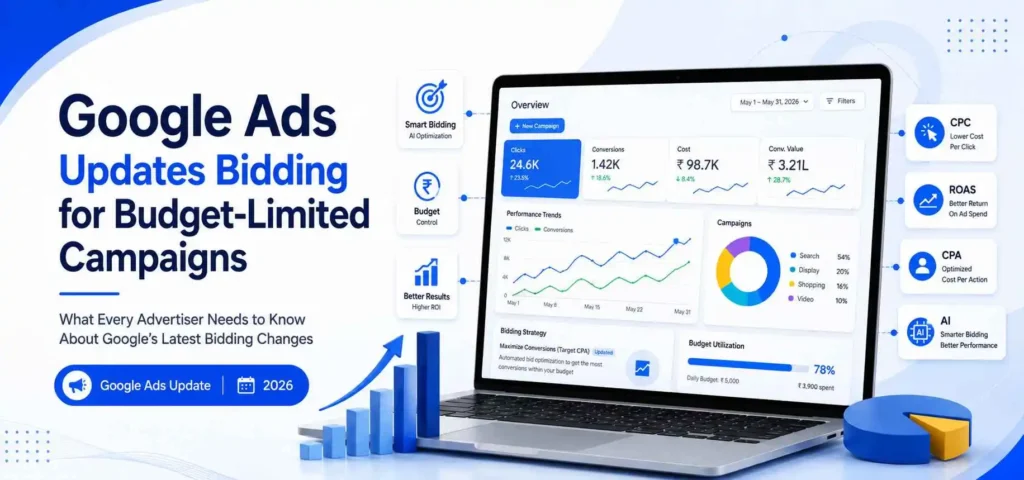
Google Ads has announced a significant update that will affect advertisers using Target CPA (tCPA) and Target ROAS (tROAS) bidding strategies on campaigns marked as “Limited by Budget.” The change is scheduled to roll out on August 17, 2026, and could impact campaign performance if advertisers do not prepare in advance.
If your business relies on Google Ads to generate leads or sales, understanding this update is essential.
What Is Changing?
Currently, some budget-limited campaigns perform better than their assigned Target CPA or Target ROAS. For example, if your Target CPA is ₹800 but Google consistently delivers conversions at ₹450, the system may continue outperforming your target.
After the update, Google Ads will optimize campaigns to perform much closer to the target you have set, even when the campaign is limited by budget. This aims to make campaign performance more predictable, but it may also increase your actual CPA or reduce your ROAS if your targets are not updated.
Which Campaign Types Are Affected?
This update applies to campaigns using target-based bidding strategies, including:
- Search Campaigns
- Shopping Campaigns
- Performance Max Campaigns
- Demand Gen Campaigns
Advertisers using Target CPA or Target ROAS should review their accounts before the update takes effect.
Example of the New Behavior
Suppose your campaign has:
- Target CPA: ₹1,000
- Actual CPA: ₹600
- Status: Limited by Budget
Before the update, Google might continue generating conversions at approximately ₹600.
After August 17, 2026, Google will aim to deliver conversions closer to your ₹1,000 Target CPA unless you manually adjust your bidding target.
What Should Advertisers Do?
To maintain strong campaign performance, consider the following steps:
1. Audit Budget-Limited Campaigns
Identify campaigns showing the Limited by Budget status and review their current CPA or ROAS.
2. Compare Targets with Actual Performance
If your campaigns consistently outperform your targets, update your Target CPA or Target ROAS to reflect current performance.
3. Use Google’s Bid Target Adjustment Tool
Google is introducing a new tool that helps advertisers review historical performance and update bidding targets more efficiently.
4. Increase Budget Only When Necessary
Increasing your budget can help scale successful campaigns, but only after confirming that your bidding targets align with your business objectives.
5. Monitor Performance After August 17
Watch for changes in:
- Cost Per Acquisition (CPA)
- Return on Ad Spend (ROAS)
- Conversion Volume
- Clicks and Impressions
Temporary fluctuations are expected as the new bidding behavior rolls out.
Why This Update Matters
This change gives advertisers more predictable campaign performance, but it also means outdated bidding targets could reduce efficiency or increase advertising costs.
Businesses that review and optimize their campaigns before the rollout will be in a stronger position to maintain profitability and avoid unexpected changes in performance.
Need Expert Google Ads Management?
At Search Engine Lab, we help businesses maximize every advertising rupee through data-driven Google Ads management, advanced bidding strategies, and continuous campaign optimization.
Get FREE PPC Services in Mumbai
Looking to improve your Google Ads performance?
Search Engine Lab offers a FREE PPC consultation in Mumbai, including:
- Google Ads Account Audit
- Campaign Performance Analysis
- Keyword Research
- Conversion Tracking Review
- Budget Optimization Recommendations
- ROI Improvement Strategy
Whether you’re running Search, Shopping, or Performance Max campaigns, our PPC experts can help you achieve better results while controlling your advertising costs.
Contact Search Engine Lab today and discover how smarter PPC management can generate more leads and higher ROI for your business.
Final Thoughts
Google’s upcoming bidding update is one of the most important Google Ads changes of 2026 for advertisers using Target CPA and Target ROAS strategies. Reviewing your budget-limited campaigns now can help protect your performance and ensure a smooth transition when the update becomes effective on August 17, 2026.